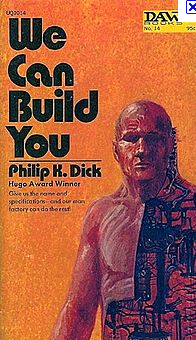
We Can Build You was written by Philip K. Dick and published in 1972. Rolls along nicely for this is the book written directly after Man in the High Castle, I was like, man he's taking it easy here; this is normal robot stuff, but then, wham! the usual robot maker stuff..."why do you do the things you do; why do you want the things you want...who is programmed? who's the robot?" is augmented by a serious case of the patented Philip K. Dick "Things are not as they seem, sour milk masquerades as cream..." jacked up by a heavy dose of schizophrenia...so this nice little book isn't quite so nice now, izzit? The woman as love interest in here bites, too, if she in fact, uh, exists! A portrait of living hell; the kind that makes a man feel alive!
Dick has a lot to say here about the program of love here, and man it hurts...this nutcracker is recommended!
"This is a very neurotic person, the ship realized. I am having an awful lot of trouble finding happy memories. There is too much fear in him and too much guilt. He has buried it all, and yet it is still there, worrying like a dog worries a rag. Where can I go in his memories to find him solace? I must come up with ten years of memories, or his mind will be lost." I Hope I Shall Arrive Soon is a collection of short stories written by Philip K. Dick, the most effective being one that was originally entitled Frozen Journey and published in Playboy Magazine in 1980. It is a tough and emotional roller coaster ride that, well, is about life itself; and time, and the perception of time, and of how the human brain is constructed to love and concentrate on the things that are good for it by it's nature, but then sometimes things happen, and even though you may mean well, well; things disintegrate, relationships change, people move in and out of your life; it's precarious enough...now add a long space trip and some faulty suspended animation and a well meaning computer to the equation....mmmmmmm.......It's a Modernmoonman favorite....a timeless classic....... there's a great review by "A Customer" on Amazon that, for the sheer excellence and Duende of it, ah, I just gotta steal it (!):
"Philip K. Dick was one of science fiction's short story "master craftsmen", though he was better known for his novels. His short stories are reminiscent of Frederic Brown's, but usually Dick's were better paced and fuller. Published almost exclusively in SF magazines, most of his best stories were printed in Del Ray's "The Best of Philip K. Dick" collection. A good handful of these are some of the authentic gems of short SF. Towering above all the others (including the others collected in this volume), however, is "Frozen Journey", published in this volume with the less effective title "I Hope I Shall Arrive Soon". This was one of the first Dick stories to see "mainstream" print, as it first appeared in "Playboy", usually the domain of writers like Roth and Mailer. This short story brings together so many Dick themes in one place, it's like a pure distillation of his explorations; the unclear nature of reality, the difficulty of gender relations, the mistrust of technology, and the tendency to mental instability. But there is also something new here, a powerfully moving evocation of the effect of one man's guilt and sorrow on his consciousness and his resulting isolation from other people. In this story, Dick is able to wed his well-noted ontological ambiguity seamlessly with his compassion for humanity's predicament, something only partially achieved by his best novels (though some come close, notably "Do Androids Dream of Electric Sheep?"). All of the elements of the story serve to demonstrate the central tragedy, bring us in to the heart of the protagonist, make us see through his troubled eyes (even at the reality he has become blind to), and move us to reflect on the profound metaphor Dick has created: life as a frozen journey through space, alone with the shadows in our minds and hearts, broken by the sorrows of lost love, corrupted conscience, impending decay and death. Not since the "half-life" concept in "Ubik" has Dick created such a potent and bleak image. To my mind this story represents a special kind of apex for Dick, his deepest expression of tragedy. It deserves to stand among the best such in English in short story form."
The Minority Report is a short story written by Philip K. Dick and published in Fantastic Universe Magazine in 1956:
The story is about 30 pages long; it's a classic tale about a man named John Anderson, who is the head of a police agency in the future called "Precrime." It's an agency designed to prevent murders before they happen with the "help" of three mutant "precogs;" strange humans with special mental powers that enable them to see the future. The "precogs" are kept in a tank of chemical solution against their will, they are tools and are used by the government to control the population. Published just 6 short years after Orwell's 1984, this story is sleek and streamlined, with Dick's prose at it's leanest...seriously, omit a paragraph, and the whole thing falls apart, he's so economical here, that he accomplishes a hell of a lot in 30 pages.
It's a story where the government establishes a corrupt system that can instantly declare a citizen a threat to national security, and a potential murderer, and hence, the accused individual forfeits his rights to freedom and all of it's privileges. They can be imprisoned and held indefinitely. Violators are placed in a detention camp. It's about how society is affected when a too powerful military wants control.
Pause.
Stephen Spielberg made this short story into a major Hollywood film in 2002. I saw it in the theater then, and thought it was really good...I just watched it again, and was blown away by it; This Film Has Grown In Stature! Republicans may complain about too much government, but never want to cut the military's budget; the change in surveillance laws during "The Bush Years" has been mirrored by this film; it's about control, control, control, and the rich have got their channels in the very bedrooms of the poor, now don't they. (Thanks, Leonard.) Spielberg added some pretty cool shit to the original story, the eye scans, the character development of Anderson as a man who lost a child and his family, and the ADS, the advertisements that hound him wherever he goes are freaking great! : The film is actually better than the Philip K. Dick original, and Tom Cruise, he's pretty great in this film:
This is solid gold, If you haven't seen it, please do, and even if you have, it's worth a re-look!
Blade Runner is a movie from 1982, directed by Ridley Scott, that was based on Philip K. Dick's 1968 novel Do Androids Dream of Electric Sheep? The movie is one of the greatest science fiction films ever made. The book is very different from the movie; more meditative. It's a story about a bounty hunter Rick Deckard, and his job of hunting down "replicants," or "genetically modified organisms" that are very close to human beings, except that they have a lack of empathy and a life span of four years. In the novel, the Earth of 2019 is a dystopia, a dust covered world decaying into ruin:
"In addition, no one today had remembered why the war had come about or who, if anyone, had won. The dust which had contaminated most of the planet's surface had originated in no country and no one, even the wartime enemy, had planned on it. First, strangely, the owls had died. At the time it seemed almost funny, the fat, fluffy white birds lying here and there, in yards and on streets; coming out no earlier than twilight as they had while alive the owls escaped notice. Medieval plagues had manifested themselves in a similar way, in the form of many dead rats. The plague however had descended from above.
After the owls, of course, the other birds followed, but by then the mystery had been grasped and understood. A meager colonization program had been underway before the war but now that the sun had ceased to shine on Earth the colonization entered an entirely new phase. In connection with this a weapon of war, the synthetic freedom fighter, had been modified; able to function on an alien world the humanoid robot--strictly speaking, an organic android--had become the mobile donkey engine of the colonization program. Under U.N. law each emigrant automatically received possession of an android subtype of his choice, and, by 2019, the variety of subtypes passed all understanding, in the manner of American automobiles of the 1960s.
That had been the ultimate incentive of emigration: the android servant as carrot, the radioactive fallout as stick."
The replicants Deckhard hunts have made a violent escape from the Mars colony, where they were property and slaves, and have assimilated themselves back on Earth. There are some great questions raised in the novel, and things are very ambiguous: What does it mean to be human? Are replicants human? Some humans lack empathy; is Deckhard a replicant? Is the struggle to raise oneself up out of entropy and decay only a human endeavor? Is spirituality real? In a world where everything is artificial: pets, emotions from a "mood organ," the religion "Mercerism," what is real? What is reality? What do replicants read on Mars? Answer: "Pre-colonial fiction. Stories written before space travel but about space travel." They read Science Fiction! The book is a good read, especially if you are a fan of the movie.
One of the greatest scenes in film isn't in the book; Rutger Hauer wrote it (!) and he really nails this scene, here it is: