Modernmoonman. Science Fiction book reviews.
Science Fiction Book Reviews and Stuff...
Wednesday, June 8, 2011
Space Plague
The Space Plague was written by George O. Smith and published in 1956. It reads like 1956, as in it's dated as hell, but in the best way.... It's a pretty good pulp yarn about a disease from outer space that either kills you or turns you into a superman; it's very Invasion of the Body Snatchers, with some veiled political content probably having something to do with some 1950's conception of an anti-communist underground railroad, but it mostly reads like a hard boiled 50's X-files. Telepathy (Mind reading) and E.S.P. (Extra Sensory Perception) are also convincingly explored here. This was a good clean fun read, and with prose like:
"Nurse Farrow made a wry face as though she'd just discovered that the stuff she had in her mouth was a ball of wooly centipedes..."
Man, the wooly is what seperates good writing from great, and I'd have to say that this book really needs a sequel, especially with some serious-ish content sprinkled in there like:
"The entire human race is lambasted by one form of propaganda or another from the time the infant learns to sit up until the elderly lays down and dies. We're all guilty of loose thinking...."
Blah, blah, blah, it goes on, and it's all over the place pulp. 1956. Not quite all there; pretty vital, not essential, but still kinda neat. And the cover design is a real winner! Viva sci-fi pulp!
Thursday, June 2, 2011
Metal Machine Music by Lou Reed
Modernmoonman song of the day: Metal Machine Music, by Lou Reed, released in July 1975, and ahead of his time...:
Timescape
"I laugh at what you call dissolution-
for I know the amplitude of time."
-Walt Whitman
Timescape was written by Gregory Benford and published in 1980. It won a Nebula award and John W. Campbell award in 1981. I had this one in my to read pile for a while, and it's a hard science tour-de-force that I wish I had read sooner. 50% hard science and 50% character development, and utterly realistic all the way through, mainly about time-traveling-faster-than-light-tachyon-particles as a means to send messages to warn the past to prevent the present catastrophe of world-killing bacterial ocean bloom caused by fertilizer and chemical runoff into the oceans. (Phew!) Certainly plausible stuff. Plus there is a lot of stuff about class struggle to make this a relatively contemporary update of Wells' archetypal Time Machine. Connie Willis' Doomsday Book certainly owes a lot to this book as well...can anyone tell me why is Cambridge the center of time travel in the world of Sci Fi? Is it cos of Wells? So Class issues can be discussed here?, so much more easily than in America?, and does the continent matter cos America has no class (but of course we do)? Of special interest is his conception of time itself as the great unknown topic in physics, in that those tachyons travel faster than the speed of light, so like they can travel to the past and warn them about our ever fucked up present, and we can avoid all of this environmental nonsense, and a doom straight outta Day of the Triffids....
"The past is not ever dead,
it's not even past"
-William Faulkner
Sure, Mr. Benford name drops all the coolies like Philip K. Dick, Herbert Marcuse, and Richard Feynman, but what he really excels at doing is creating that elusive sense of wonder...and making physics dramatic, poetic, and mind blowing... I folded many pages over by the halfway point (to re-read)....and the final pages of this novel are fantastic and moving, and this book has been one of Modernmoonman's faves since I started this blog.... Here's a taste of the text:
"Look, the point here is that our distinctions between cause and effect are an illusion. This little experiment we've been discussing is a causal loop --no beginning, no end. That's what Wheeler and Feynman meant by requiring only that our description be logically consistent. Logic rules in Physics, not the myth of cause and effect. Imposing an order to events is our point of view. A quaintly human view, I suppose. The laws of physics don't care. That's the new concept of time we have now--as a set of completely interrelated events, linked self-consistently. We think we're moving along in time, but that's just a bias."
"But we know things happen now, not in the past or future."
"When is 'now'? Saying 'now' is 'this instant' is going around in circles. Every instant is 'now' when it 'happens.' The point is, how do you measure the rate of moving from one instant to the next? And the answer is, you can't What's the rate of the passage of time?"
"Well it's--" Peterson stopped, thinking.
"How can time move? The rate is one second of movement per second! There's no conceivable coordinate system in physics from which we can measure time passing. So there isn't any. Time is frozen, as far as the universe is concerned."
This is a great Book, and a great introduction to the "Hard Sci Fi" writing of Gregory Benford.
Wednesday, June 1, 2011
We Can Build You
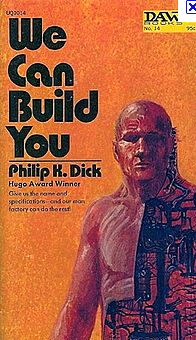
We Can Build You was written by Philip K. Dick and published in 1972. Rolls along nicely for this is the book written directly after Man in the High Castle, I was like, man he's taking it easy here; this is normal robot stuff, but then, wham! the usual robot maker stuff..."why do you do the things you do; why do you want the things you want...who is programmed? who's the robot?" is augmented by a serious case of the patented Philip K. Dick "Things are not as they seem, sour milk masquerades as cream..." jacked up by a heavy dose of schizophrenia...so this nice little book isn't quite so nice now, izzit? The woman as love interest in here bites, too, if she in fact, uh, exists! A portrait of living hell; the kind that makes a man feel alive!
Dick has a lot to say here about the program of love here, and man it hurts...this nutcracker is recommended!
Wednesday, May 25, 2011
Beyond the Blue Event Horizon
Beyond the Blue Event Horizon was written by Frederick Pohl and published in 1980. It's #2 of the "Heechee" saga....and it is the sequel to the Hugo and Nebula award winner Gateway...it's a good read, though nothing quotable....Pohl ups the science a lot here with a lot of talk re: the huge black hole Robinette Broadhead has left his lover marooned at....he really gets into explaining how the mass of the black hole affects time at the event horizon so that the main protagonist can live a lifetime as his lover lives only a few seconds....he plans to swoop in and save her, natch, as Pohl makes with the sexy talk and the talky sex as Robinette Broadhead kills time....Kewl (cool) ...."Heechee Rendezvous" is next....but, well....no rush....sorry Mr. Pohl!
Gateway
Gateway was written by Frederick Pohl and published in 1977, when it won both the Hugo and Nebula award. In other words, it's a masterpiece, book one of the "Heechee" saga, eh? Well, it's a pretty damn good read, that's for sure. But it's like butter, or silk, or gossamer....or some other seemingly insubstantial thing that turns out to be....strong stuff. Too much psycho-analysis for my taste, but the twist at the end is killer, and the book is hard science (in the best way) yet also about human relationships (in the best way). Classic space opera, too. The next book ups the hard science part....but never really tops "Gateway"....still, I can see why this is a classic...though nothing is quotable...oh well...strong stuff from Frederick Pohl in 1977.
Subscribe to:
Posts (Atom)